Article By: Cindy Ross
The cool, dark, peaceful forest has always been our happy place. Long before I learned the research of how good it is for mind and body, we went there because being in the forest simply made us feel happy. There isn’t anything larger, more grand and beautiful in our state than the Allegheny National Forest (ANF), the 500,000+ acre recreational playground that we are so fortunate to have. Naturally, when I desperately needed to find a place of respite, it was to the ANF where I turned.
A few years ago, my very athletic, adventurous husband, Todd Gladfelter, suffered a devastating fall, which broke his neck and resulted in an incomplete spinal cord injury. Since then, we have not been content with a life indoors, away from the beauty of nature, it’s calming peace and many health benefits. We utilized local trails to help him regain some mobility, using a manual wheelchair and a walker, but longed for a larger scale. A road trip to the ANF was in order.
Ever notice that you rarely see a disabled person out and about in the great outdoors? I never gave it a minute’s thought until Todd’s accident turned him into a quadriplegic. And then I learned why. It’s because they think if there was a way to get their loved one into the healing, peaceful natural world, it would probably be way too hard. I’m here to tell you that it’s possible and the ANF is a good place to start.
One in four Americans live with a disability (61 million) which keeps them at home (1 million require a wheelchair) where they are more comfortable and their lives are safe and have a degree of accessibility. But a life indoors, surrounded by screens and technology, robs you of the beauty and the wonder of the natural world. Studies in recent years have found that eco-therapy, simply spending time in nature, actually helps and heals you, be you a disabled person or a stressed-out human who needs a break. Being in nature elevates everyone’s mood, as it actually changes your brain’s waves to calming alpha waves and releases serotonin in your body, the feel-good hormone.
WALKING/ROLLING
Todd and I knew just where to get some of those alpha brain waves moving again and it was Heart’s Content Natural Scenic Area, an incredible old-growth forest with a 1/3 mile long interpretive trail. Todd can walk some with a walker or a Rollator but we push his manual wheelchair along when do a longer trail and he needs to rest. An “interpretive” trail does not necessarily mean “accessible” so we went into it with options. If we happened to hit a particular rough spot, Todd got up and walked with his walker/Rollator.
Our friends, Walt and Leslie Krater visited the ANF with us, for their great company and even more important, help. It is wise to bring along a helper or two if you encounter some rough going or an unexpected downed tree, for example.
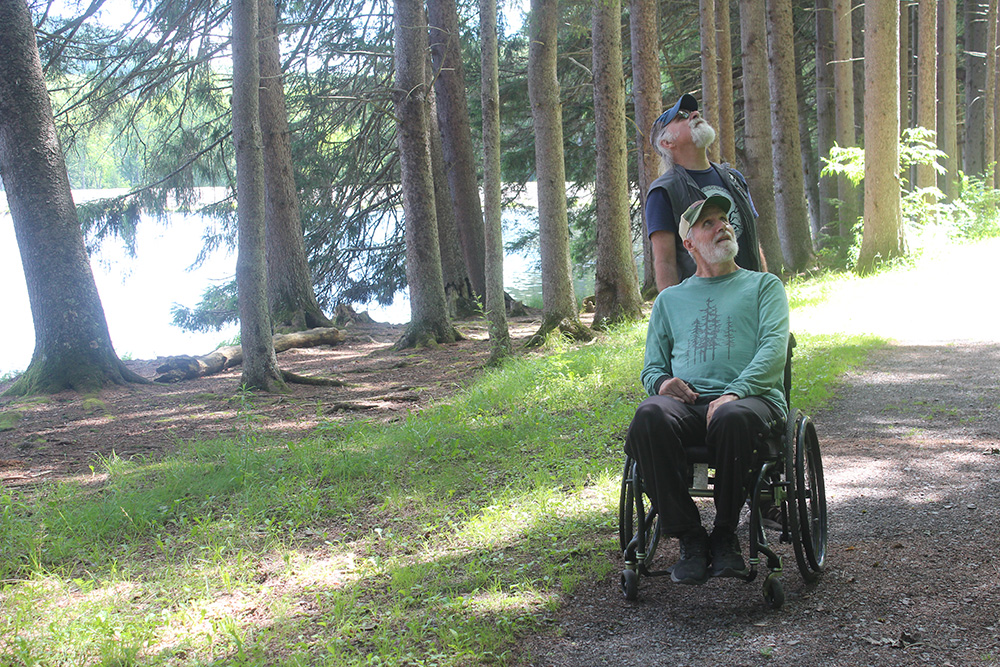
Heart’s Content is a Registered Natural Landmark featuring some 3-400-year old hemlocks and white pines throughout its 122-acres. You merely have to travel a few yards down the trail before you encounter some of the big trees the scenic area is so famous for. Todd sat down periodically so he could marvel at the massive trunks and breadth of the trees and tilted his head way back to see skyward. A happy smile stayed on his face the entire trail as around every corner is another old growth friend that filled us with beauty and happiness—and gratitude that they are still here for us to enjoy. It wasn’t long before Todd realized what a gift it is to be back in these big beautiful trees again. Not long ago, he figured they would only be a memory from his past.
Although the hemlock old growths are still here, they are being severely threatened by an imported infestation of the hemlock woolly adelgid. This highly destructive insect arrived in the states back in 1951 but did not enter the ANF until 2014. Since then, widespread biological methods of control have been implemented, hoping to keep the big trees safe. There are many giant hemlock trees still here, compared to other places in the state where hemlock forests have been reduced to sickly shadows of what they once were. Still, the time to see the old growth is ASAP, whether you are disabled or able-bodied.
Another interpretive trail in the ANF that we visited is the Bluebird Loop, which is part of the Timberdoodle Interpretive Trail system located off of PA 59, outside Lewis Run. This flat, grassy trail seems to have fine millings under it to help harden it up. It is named after the American woodcock (whose other name is timber doodle), a bird that is a native to the eastern U.S. The Bluebird Loop is half a mile long with interpretive signs about the environment and the managed wildlife area. It is far different from the old growth forest, but very enjoyable. The 1.25 mile Woodcock Trail curves off of the Bluebird Trail and can be covered if you have the capacity (a bit too far and too challenging to push my husband in his chair or for him to walk).
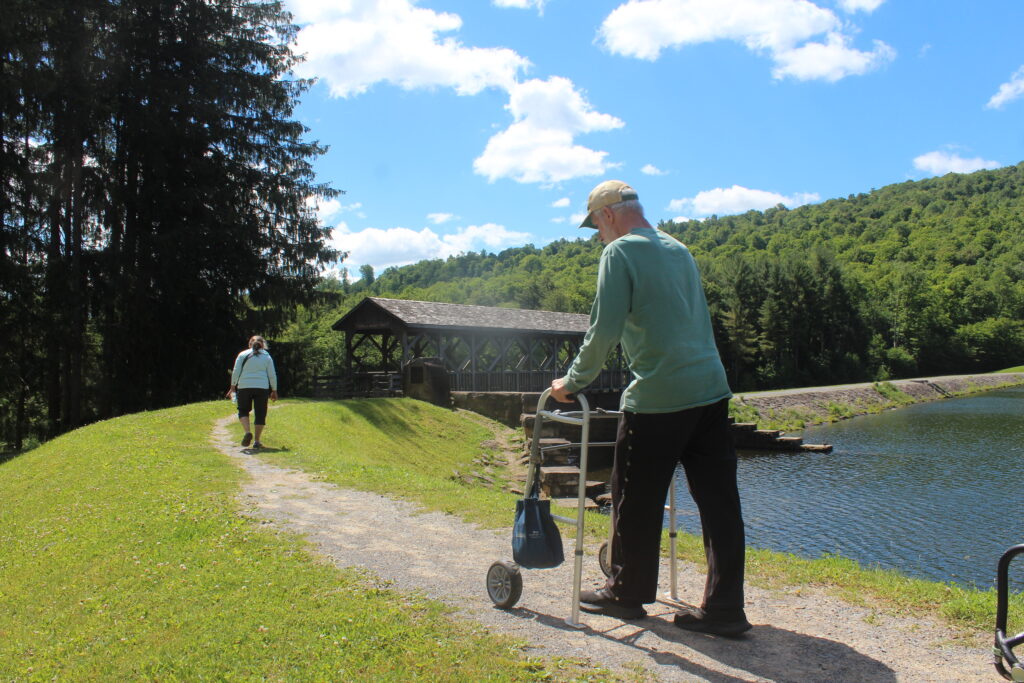
Right outside the national forest is another beautiful trail that most mobility challenged folks can enjoy—the Marilla Bridges Trail in Bradford on Rt 346. This 1 mile loop is considered the prettiest mile walk in the state as it loops around the reservoir, first crossing through the 65-foot long Eric Benjamin covered bridge. The trail surface is packed dirt and gravel, with some larger stones across the dam breast and leading up to the covered bridge, which were the most challenging to navigate, but well worth the side trip.
CYCLING
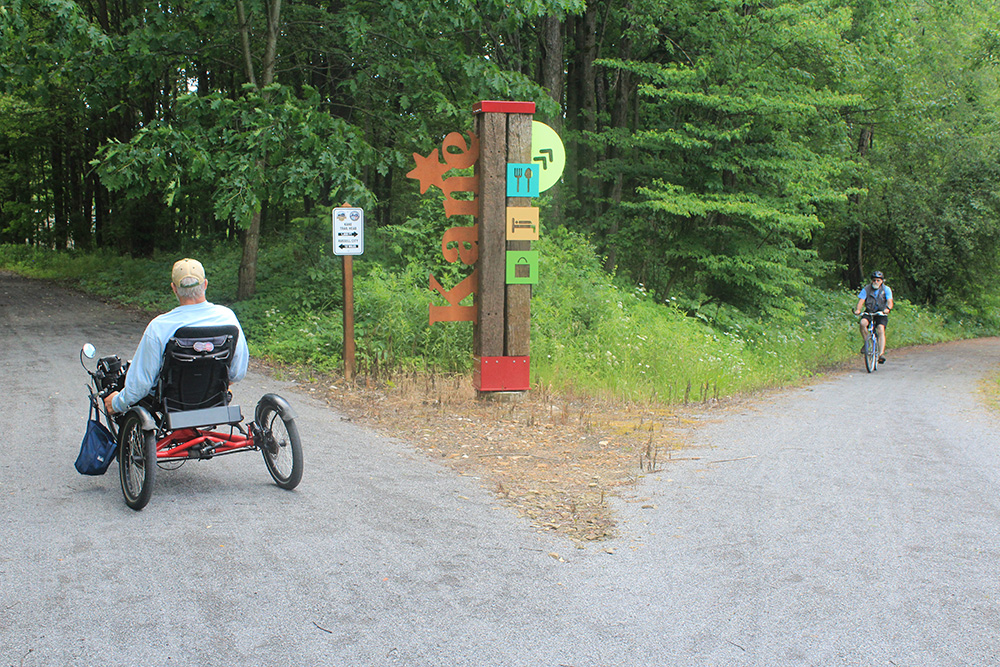
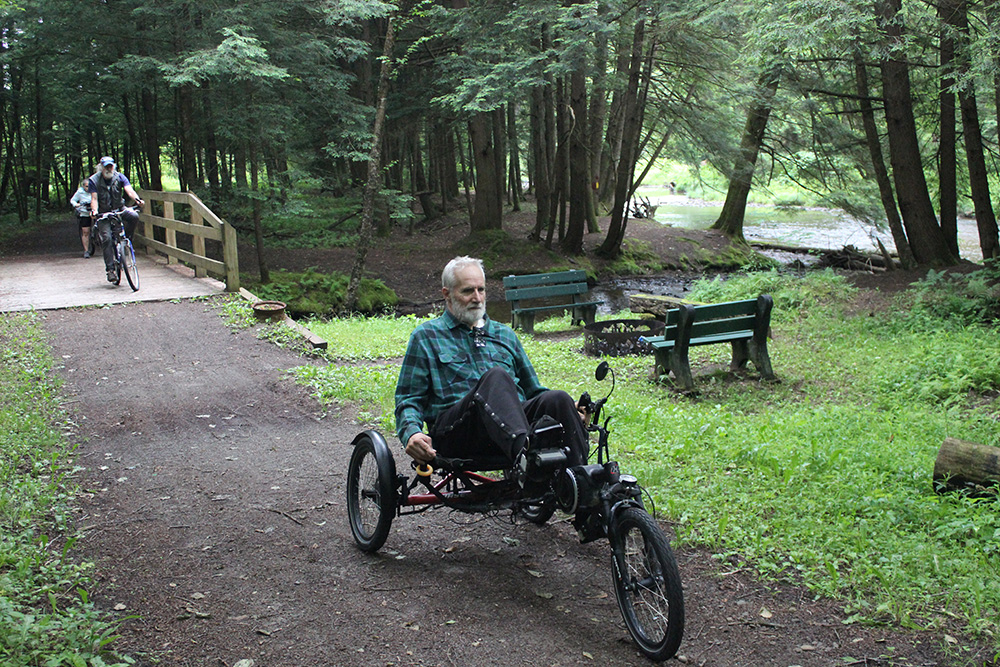
Besides walking in the ANF, there are a few amazing opportunities to cycle. Todd rides an adaptive, e-assist, recumbent trike which is very stable. We set our sights on the Kinzua Valley Rail Trail and the Knox & Kane Rail Trail.
On a bike, Todd is free to look around and take in the peace of the forest, smell the pines, watch colored leaves float down, chipmunks scamper across the trail and shy deer come out to feed in the evening. And he can move FAST! There are not many opportunities for a disabled person to move quickly through their world, under their own power, and feel the thrill of wind and air on their face, but it can happen on a bike on an open, wide trail.
One end of the trail kicks off at the Kinzua Bridge State Park, which is highly accessible for the mobility challenged, and ought to be checked out first to learn about the bridge and the railroad’s fascinating history. A wheelchair can easily move around the well-done little museum at the visitor’s center, and offers an elevator to effortlessly move to the second floor. A smooth, black-topped trail gradually descends to a viewing platform of the bridge and on to the skywalk, when it is open in the fall, (when reconstruction is halted for leaf-peeping), or when the decking is complete in 2027.
The Kane & Knox Trail is presently 31 miles long (will be 74 when completed) and follows the path of a narrow-gauge railroad. We hopped on in the town of Kane, and headed in both directions, south into the national forest where the surroundings turn wild, and north towards the country club (where you are alerted to watch for flying golf balls!), so we could take advantage of the delicious ice cream at Country Pines on Route 6. They are famous for their generous portions of their tasty ice cream, with convenient Adirondack chairs and shaded picnic tables to enjoy it, easily accessible for anyone. The trailhead in Kane features a beautiful sculpture at the railroad station, of a jumping fish made of recycled bicycle parts!
One of the most amazing things about cycling rail trails as a disabled person is you forget about your disability, and just dissolve into the beauty and peace of the natural world. You don’t have to worry about vehicular traffic, or be hyper focused about radical turns and obstacles. Cycling rail-trails makes Todd feel normal for the first time since his tragic accident, and they make us able-bodied folks pretty happy too.
CRUISING
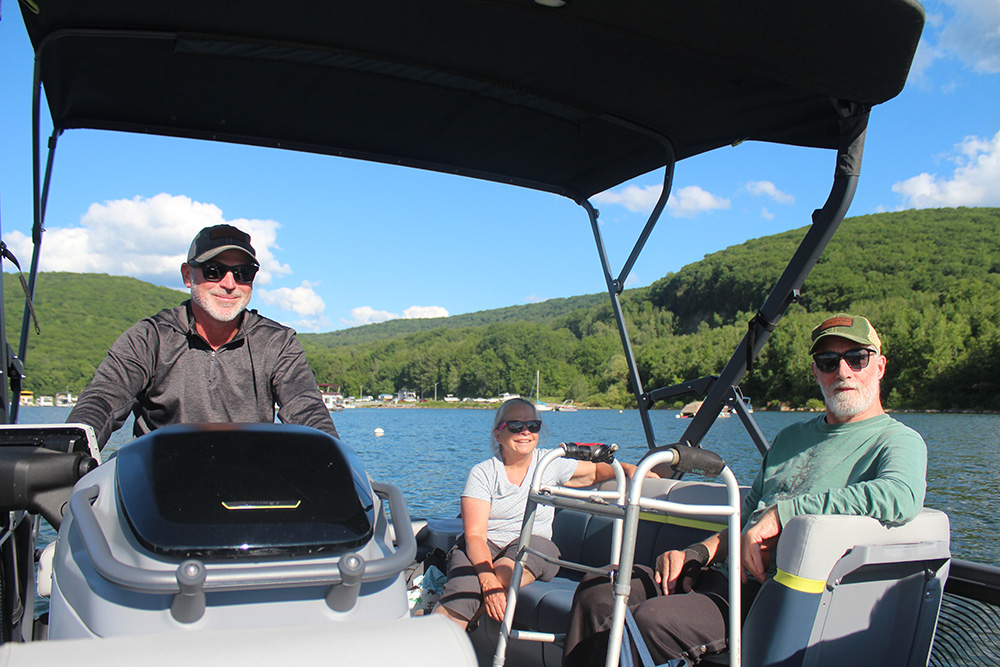
We wanted to get Todd to a good viewpoint of the massive Allegheny Reservoir so we drove the scenic Longhouse National Scenic Byway around the Kinzua Arm of the reservoir, stopping at a few overlooks. Of course, viewing this expansive lake only got us more excited to get on it in a boat, for the ultimate experience. We were able to drop Todd off at the dock and easily walk the ramp out to a pontoon boat for a beautiful evening ride. The Kinzua Wolfrun Marina offers pontoon boats to rent that your disabled loved one can easily navigate into. We watched ospreys and bald eagles soar overhead and the sky turn rosy and peach-colored as the sun began to set, creating the perfect ending to a fantastic visit to the Allegheny National Forest.
Our mobility challenged loved ones are not the only folks who could use a dose of the natural world. Family caregivers also need little nature get-aways to renew their strength and enable them to do the very important work of keeping another human being alive and healthy. Caregiving takes a toll on a person’s mental as well as physical health but they must honor their needs. Taking their disabled loved one to natural areas like the ANF also helps them in all the same positive ways.
The life of a disabled person can feel very small and limited, besides enormously challenging and difficult. That goes for the caregivers too- the quiet, unsung tired heroes, holding it all together. Spending time in the natural world like the ANF can fill all of our lives with so much joy and a feeling of great peace. We can forget life’s hardship and feel connected to a larger, more beautiful world.
SIDEBAR
Cook Forest State Park, a close neighbor to the ANF, has recently implemented the fully accessible Sensory Trail. This quarter mile paved trail is the first of its kind in Pennsylvania. It winds visitors through a beautiful forest with old growth evergreens and hardwoods. A visually impaired person can hold on and follow the accompanying cable along the trail, which also aids folks with autism to feel grounded. There are interpretive signs in braille and raised printed letters for sighted visitors as well, sharing fascinating information about the forest. A wheelchair bound visitor or just a mobile impaired person will find the smooth, recently resurfaced trail a breeze to navigate, even if you were rolling yourself along. The plastic-coated guide cable that runs along the trail has geometric discs along it indicating features that are ahead such as signs and benches. There are four wheelchair accessible picnic tables at the entrance for everyone’s enjoyment. The Friends of Cook Forest, a volunteer, non-profit group working to enhance the state park, as well as donors, DCNR, and the park staff helped to make the Sensory Trail a reality.
Accessible nature is something that everyone who creates open spaces in communities is implementing because folks are realizing that the disabled need to get outdoors as much as anyone, and maybe even more, and have been greatly overlooked. The Outdoors for All Act is expanding access and creating grant funding to ensure that natural spaces are available and accessible to local communities. The bill provides project expenses for new parks, renovating existing recreation facilities, and developing infrastructure supporting outdoor education and public land volunteerism.
SIDEBAR
Although the ANF is free to enter and enjoy, (as well as all Pennsylvania state parks), having a National Park Access Pass as a disabled person will award you half price on the camping fees at the 17 federally run campgrounds, as well as a few run by the U.S. Army Corp of Engineers in the ANF. An Access Pass can be obtained free of charge for those who are permanently disabled, giving you free access into all national parks and national monuments. https://www.nps.gov/subjects/accessibility/interagency-access-pass.htm